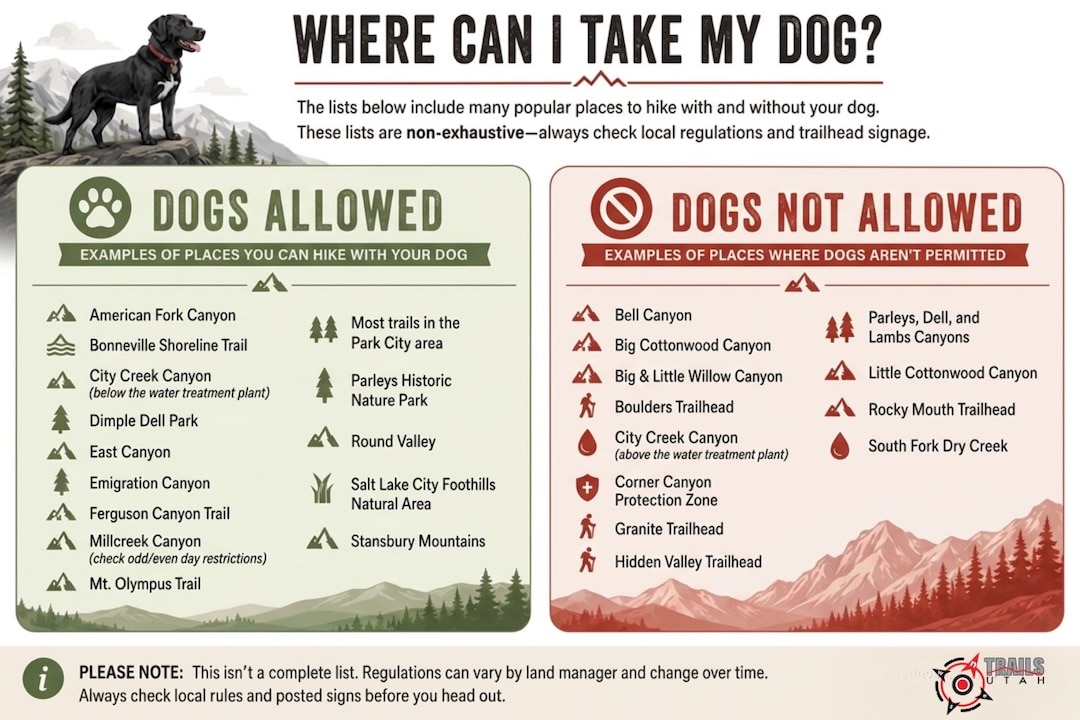
If you’ve ever headed up Big Cottonwood, Little Cottonwood, City Creek (above the treatment plant), or Parley’s Canyon with your pup, you’ve likely seen the “No Dogs Allowed” signs and wondered why. These rules aren’t arbitrary—they protect Salt Lake City’s drinking water supply, which comes largely from snow and rain in these canyons. In fact, about 60% of the community’s water starts right here in the Wasatch Front.
Here’s what every dog owner should know about the Wasatch Front’s protected watersheds, plus where you can enjoy the trails with your four-legged friend.
A watershed is where our drinking water begins. Snowmelt and rainfall in the Wasatch canyons supply about 60% of Salt Lake City’s drinking water. From the top of Silver Lake in Big Cottonwood, it takes just 24 hours for that water to travel from snowpack → canyon stream → treatment plant → your faucet.
Because of this direct connection, dogs and other domestic animals are prohibited in protected watershed areas. Their waste can introduce harmful bacteria and parasites into streams that feed directly into our water supply.
Violating these rules isn’t just bad etiquette—it’s a Class B misdemeanor, enforceable by fines or even jail time.
* Exceptions are made for permitted dogs registered to canyon residents, ADA service animals, and officially sanctioned Search and Rescue animals.
Dogs don’t use restrooms, and with millions of annual visitors to these canyons, even a small number bringing pets would mean a dangerous amount of waste entering streams and lakes. Dog waste can carry harmful bacteria such as E. coli and parasites like giardia, which pose health risks to both people and wildlife.
Wildlife in these canyons also leave waste, but the difference is in biology. Native animals live within their natural ecosystem and rarely carry the same human-adapted pathogens found in domestic pets. Dogs, on the other hand, often harbor bacteria and parasites that can contaminate drinking water and spread human-borne disease.
It may be tempting to bring your dog along and leave them in the vehicle, but this isn’t safe—or legal.
Safety first: Mountain weather can swing from hot to freezing quickly, putting pets at serious risk.
Biology second: Dogs in cars still need bathroom breaks. Allowing waste in watershed parking areas is equally harmful.
For these reasons, dogs are not allowed in vehicles within protected watersheds.
The good news is that there are plenty of places across the Wasatch Front and Utah where you can hike with your dog. The graphic above highlights a few of the most popular places where dogs are and aren’t allowed.
Beyond Salt Lake, you’ll find options in American Fork Canyon, Park City Rail Trail, Rose Canyon/Yellow Fork, Davis County canyons, the Stansbury Mountains, and most Utah State Parks (with the exception of Rock Cliff at Jordanelle). Remember: leashes under six feet are required in State Parks.
The Bottom Line
Protected watersheds are essential to our health, and keeping them clean is everyone’s responsibility. By respecting the rules, we ensure safe, high-quality drinking water while still enjoying Utah’s vast network of dog-friendly trails.
Tip: Always carry waste bags and pick up after your dog. There’s no “poop fairy”—what you leave behind doesn’t just disappear.